

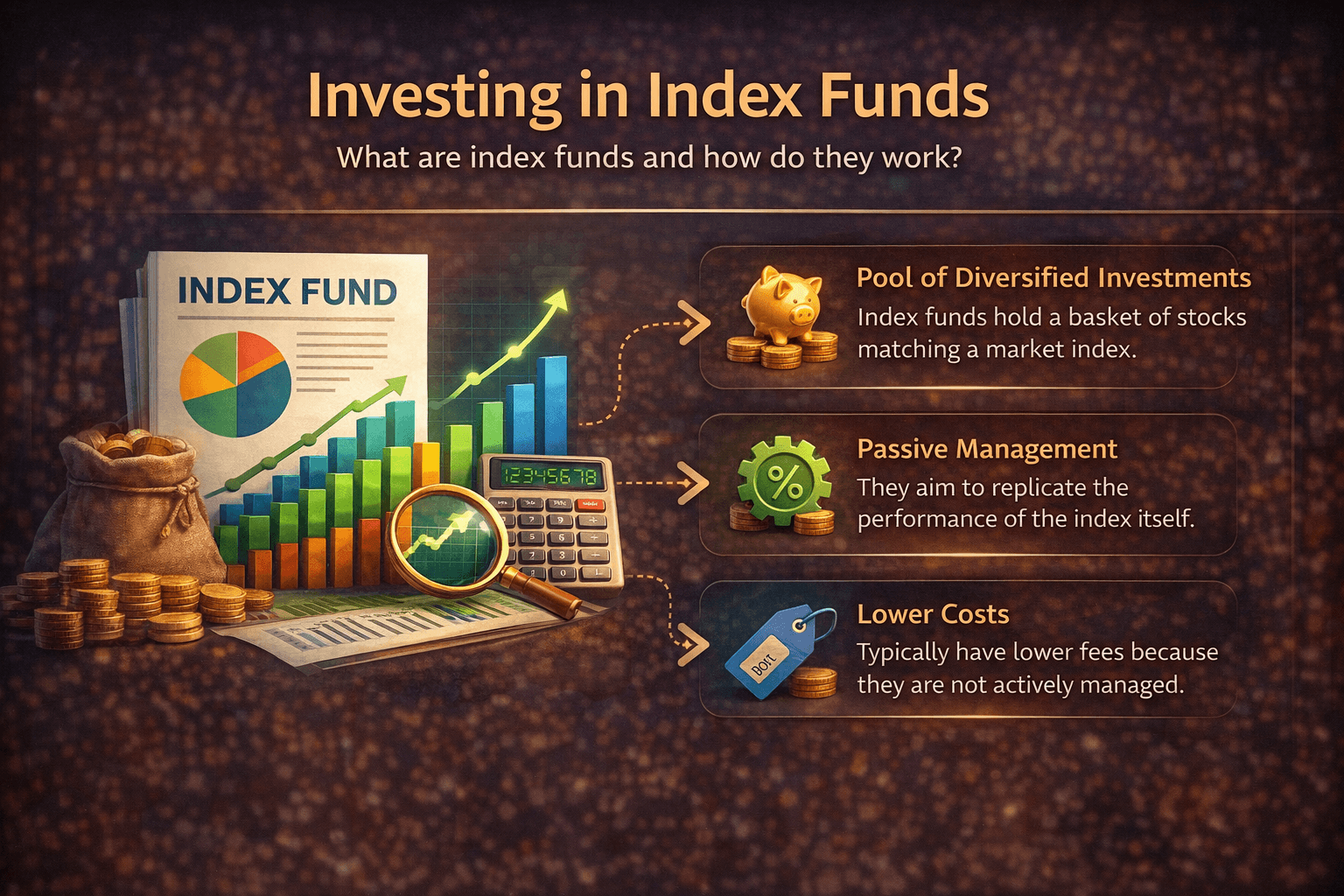
Confused about index funds and their role in the investing world? You’re not alone—many beginners grapple with the overwhelming jargon and concepts.
This in-depth guide will both clarify the concept of index funds and enhance your investment knowledge.
Quote
“Don’t look for the needle in the haystack. Just buy the haystack!”
John C. Bogle
Big ideas
- Index funds provide a diversified portfolio by tracking entire market indices, often encompassing hundreds of stocks or bonds.
- Historically, index funds tend to outperform many actively managed funds when fees are considered due to lower transaction costs.
- Specifics vary among index funds; for example, an S&P 500 fund tracks large-cap U.S. stocks, while a total market fund captures a broader market spectrum.
Stepping into the investment world can often feel like trying to learn a new language. You might have heard about stocks, bonds, ETFs, and more, but what about index funds?
In the next few sections, you’ll not only gain a clear understanding of what index funds are but also discover why they’ve become a popular choice among both novice and seasoned investors.
Moreover, you’ll get a snapshot of how they stack up against other investment vehicles like actively managed portfolios and learn about the potential fees associated with them.
And remember, investing shouldn’t be a daunting endeavour. With the right knowledge in hand, you can navigate the financial markets with confidence. Consider this article your friendly guide to the world of index funds. Whether you’re looking to diversify your portfolio or seeking a low-cost entry into the market, by the end, you’ll have a solid foundation to make informed decisions.
What are index funds? Definition and examples
An index fund is, at its core, a type of investment fund—be it a mutual fund or an ETF (Exchange-Traded Fund).
Index Fund Definition
A type of investment fund that aims to replicate the performance of a specific market index by holding all, or a representative sample, of the assets within that index.
Its primary objective? To track or mirror a specific market index.
Think of it as a reflection of a particular segment of the financial market. By investing in an index fund, you’re essentially buying a small piece of all the assets it encompasses.
Imagine the market index as a music playlist featuring the top hits from the UK charts. An index fund would be like creating your own mix from that playlist, trying to match its vibe as closely as possible. Just as each song in the playlist contributes to its overall feel, each asset within an index fund contributes to its performance.
For instance, one of the most renowned market indices globally is the S&P 500. This index captures the performance of 500 large companies listed on the US stock exchanges. When you invest in an S&P 500 index fund, you’re essentially buying a tiny share of those 500 companies. Instead of handpicking individual stocks, you’re speculating about their combined performance.
But it’s not just about the S&P 500. There are countless indices out there, from the FTSE 100, which tracks the 100 largest companies on the London Stock Exchange, to the Nikkei 225 in Japan. Each of these has corresponding index funds, allowing you to invest in a broad segment of the market without the hassle of selecting each stock individually.
To put it in more relatable terms, it’s like choosing a set menu at a gastropub. Instead of agonising over each dish, you opt for a curated selection that offers a bit of everything. It’s simpler, often more cost-effective, and you get to experience a variety of flavours.
In essence, index funds offer a diversified, straightforward, and often more affordable way to tap into the financial markets. And with so many options available, there’s likely an index fund that aligns with your investment goals and risk appetite.
Distinguishing index fund terminologies
We’ve just touched upon what an index fund is, but there are other terms floating around that might sound similar. Let’s clarify them for you:
What is an index fund?
Simply put, it’s a type of investment fund designed to mirror a particular market index, like the FTSE 100. By investing in an index fund, you’re effectively investing in a broad segment of the market it represents, offering diversification with minimal effort.
What is an indexed fund?
This term essentially refers to the same concept as an index fund. Sometimes, people use ‘indexed fund’ to emphasise the fact that the fund is indexed to, or tracks, a specific market benchmark. It’s just a slight nuance in terminology but holds the same meaning.
Spotlight on popular index funds
This table offers a concise overview of select S&P 500 and Nasdaq index funds. You should note that the information provided is for illustrative purposes and does not serve as an endorsement or recommendation.
| Fund Name | Index | Assets Under Management (AUM) | Expense Ratio | 5-Year Annualised Return (2016 to 2021) |
| Vanguard S&P 500 ETF | S&P 500 | $657B | 0.03% | 15% |
| SPDR S&P 500 ETF Trust | S&P 500 | $340B | 0.09% | 14.50% |
| iShares Core S&P 500 ETF | S&P 500 | $278B | 0.03% | 15% |
| Schwab S&P 500 Index Fund | S&P 500 | $55B | 0.02% | 14.80% |
| Fidelity 500 Index Fund | S&P 500 | $300B | 0.02% | 14.90% |
| Invesco QQQ Trust | Nasdaq | $168B | 0.20% | 23% |
| ProShares UltraPro QQQ | Nasdaq | $11B | 0.95% | 42% |
| Fidelity Nasdaq Composite Index Fund | Nasdaq | $15B | 0.30% | 22.50% |
| First Trust Nasdaq-100 Equal Weighted | Nasdaq | $1.2B | 0.60% | 20% |
| ProShares Ultra QQQ | Nasdaq | $3B | 0.95% | 40% |
Past performance doesn’t guarantee future results.
How do index exchange-traded funds (index ETFs) work?
A term you might frequently encounter is ‘Index ETF’ or Exchange Traded Fund. These are close relatives of the index funds but come with their own set of characteristics.
Сndex ETF Definition
An Index ETF is a type of investment fund that, like the broader category of index funds, aims to track the performance of a specific market index. However, the distinctive feature of ETFs is that they’re traded on stock exchanges—much like individual stocks.
Trading dynamics
If you fancy a bit of action on the London Stock Exchange or any other global stock market, you can buy and sell shares of Index ETFs just as you would with shares of individual companies. This offers an added layer of flexibility, as you can trade them throughout the day at fluctuating market prices. In contrast, traditional index funds typically have their prices set once at the end of the trading day.
Diversification with just one trade
The beauty of Index ETFs is that with a single trade, you gain exposure to a vast array of assets. Suppose you invest in an ETF that tracks the FTSE 100. In doing so, you’re investing in a representation of the 100 largest publicly traded companies in the UK, all in one go. It’s efficient, especially if you’re keen on broadening your investment horizon without the legwork of individual stock selection.
Dividends and reinvestment
Much like other investment vehicles, Index ETFs can earn dividends from the stocks they hold. You, as an investor, may receive these dividends, which can be either reinvested or taken as cash. It adds another layer to your potential returns, making ETFs an attractive option for many.
Lower costs, greater accessibility
Historically, Index ETFs have been favoured for their lower expense ratios compared to many actively managed funds. When you pair this cost-efficiency with their inherent accessibility (thanks to being traded like stocks), it’s clear why they’ve grown in popularity among both seasoned and budding UK investors.
Grosvenor Capital Brokers offers commission-free trading, allowing you to invest in trading instruments, including index funds, without the added cost of brokerage fees. This feature not only makes investing more accessible but also enhances potential returns by minimising upfront costs.
While Index ETFs offer numerous advantages, all investments come with risks. Remember, investment isn’t about following the crowd; it’s about understanding your options and choosing what fits best for you.
*Other fees may apply.
Index funds vs actively managed funds
You may find yourself at a crossroads, having to choose between index funds and actively managed funds. Both offer distinct advantages and are designed to meet different investment objectives. So, how do you discern which might be a fit for you?
Index funds: As we’ve discussed, index funds aim to replicate the performance of a specific market index. They aren’t trying to outperform it, but rather to mirror its ups and downs. By doing so, they offer broad market exposure, usually at a lower cost.
Actively managed funds: These funds have a different goal. Managed by financial professionals or teams, the aim is to outperform a particular benchmark or market index. They’ll frequently buy and sell assets, using research, forecasts, and their own judgment, in the hopes of achieving better returns than the broader market.
Active fund Definition
Investment funds managed by professionals who make specific investment decisions with the aim of outperforming a particular benchmark or market index.
Cost implications
Almost by definition, index funds have lower expense ratios. This is because they’re passively managed, meaning fewer transactions, which should result in lower associated costs.
Due to the hands-on approach, actively managed funds usually come with higher fees. The belief is that the expertise of the managers can lead to better-than-market returns, potentially justifying the higher costs.
Performance potential
Historically, index funds have provided steady, market-matching returns. While you might not ‘beat the market’ with index funds, you’re less likely to significantly underperform it either.
It’s important to note that past performance doesn’t guarantee future results.
Actively managed funds can be a bit of a mixed bag. Some outperform their benchmarks, while others don’t. It’s crucial to research and understand the track record of any fund you’re considering.
Flexibility and strategy
The strategy behind an index fund is straightforward, i.e. mirror the index. This means fewer surprises in terms of the fund’s holdings.
Active fund managers have the flexibility to pivot their strategy based on market conditions, forecasts, and research. This can lead to a wider range of outcomes, both positive and negative.
While index funds offer simplicity and cost efficiency, actively managed funds offer the potential (though not the guarantee) of outperforming the market. Choosing between the two is about finding the balance that suits you best.
Considerations for investing in index funds
As you contemplate adding index funds to your portfolio, here are a few considerations to mull over:
Diversification benefits
One of the primary attractions of index funds is the instant diversification they offer. With a single purchase, you can gain exposure to a broad swathe of companies or assets. It’s akin to spreading your bets or ‘not putting all your eggs in one basket’, which can mitigate the risk of any single asset underperforming.
Cost efficiency
Typically, index funds come with lower expense ratios than their actively managed counterparts. This cost efficiency can make a significant difference in the long run, especially when you consider the effects of compound returns. Remember, the less you pay in fees, the more of your returns you get to keep.
Tracking error
While index funds aim to replicate the performance of their benchmark index, they might not do so perfectly. This discrepancy is labelled the ‘tracking error’. It’s a good practice to understand the reasons for any substantial tracking errors when evaluating an index fund.
Market conditions
Although index funds aim to match the market’s performance, remember that when the market dips, so too will your index fund. On the flip side, when the market rises, you’re poised to benefit. It’s crucial to have a long-term perspective and not be swayed by short-term market volatility.
Liquidity concerns
Most well-known indices are highly liquid, meaning assets can be easily bought or sold. However, if you’re considering more niche or specialised index funds, it’s wise to check their liquidity to ensure you can move in and out with ease.
Dividend reinvestment
Some index funds offer a dividend reinvestment plan, allowing dividends to be automatically reinvested to purchase more shares. This can be a nifty way to compound your returns over time.
Index fund risks
Here is a table showing the main risks associated with index funds:
| Risk type | Description |
| Market risk | Reflects the overall performance of their target market or sector. A downturn in the market means a downturn in the index fund. |
| Lack of flexibility | Index funds, being static, don’t adjust based on market changes. They don’t shift during downturns or utilise emerging opportunities. |
| Concentration risk | Some index funds may lean heavily towards specific sectors or companies, leading to potential vulnerabilities if that sector/company struggles. |
| Tracking error | Discrepancies can exist between the index fund’s performance and its benchmark index. It’s essential to understand and monitor this. |
| Interest rate sensitivity | Especially for bond index funds, a rise in interest rates can lead to a decrease in bond prices, affecting the fund’s value. |
| Currency risk | For international index funds, currency value fluctuations can impact returns. For instance, a strong pound sterling might diminish returns from a foreign index fund. |
Certainly! Here’s the revised section, tailored to a reader using the Grosvenor Capital Brokers:
How to invest in index funds: Step by step guide
Ready to navigate the world of index funds using the Grosvenor Capital Brokers app? Fantastic decision! Let’s break down the journey into manageable steps:
1. Define Your financial goals
Whether it’s planning for a sabbatical, setting aside funds for your child’s education, or building a retirement nest egg, defining your goals is the first step.
2. Research different types of index fund
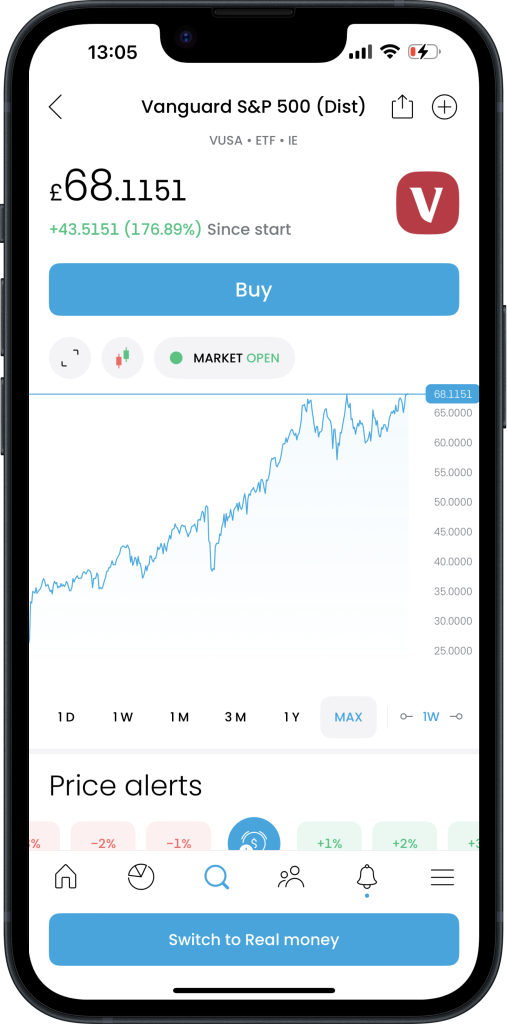
The variety of index funds is vast, ranging from those tracking global giants to specific industry sectors or international territories. Spend some quality time on Grosvenor Capital Brokers app familiarising yourself with the array of choices to determine which resonates with your financial aspirations.
3. Find out the fund’s expense ratio
While index funds are renowned for their cost-efficiency, it’s always good practice to be aware of the associated fees. The expense ratio is key – the lower it is, the more of your returns you retain.
4. What are the fund’s holdings?
Before you invest, peek under the hood. Check out the assets the index fund holds. This insight will give you a clearer picture of its diversification and if it aligns with your preferences.
5. Determine how much you’ll invest
How much are you planning to invest? Grosvenor Capital Brokers caters to a wide range of investment sizes, but ensuring your chosen amount aligns with your financial strategy is essential.
6. Execute your trade
On the Grosvenor Capital Brokers app, locate your chosen index fund, decide on your investment amount (including fractional shares) and confirm your transaction.
7. Monitor and rebalance periodically
Financial landscapes evolve. It’s prudent to occasionally revisit your investments, gauge their performance, and make adjustments if needed to stay in line with your goals.
8. Embrace a long-term mindset
Investing in index funds is more of a marathon than a sprint. While the market has its ups and downs, a steadfast and patient strategy can pave the way for consistent growth over time.
Recap
You should have a clearer understanding of index funds, their advantages, potential pitfalls, and how they can fit into a diversified investment portfolio. Whether you’re a seasoned investor or a beginner, this knowledge should serve as a solid foundation as you navigate fund investing.