

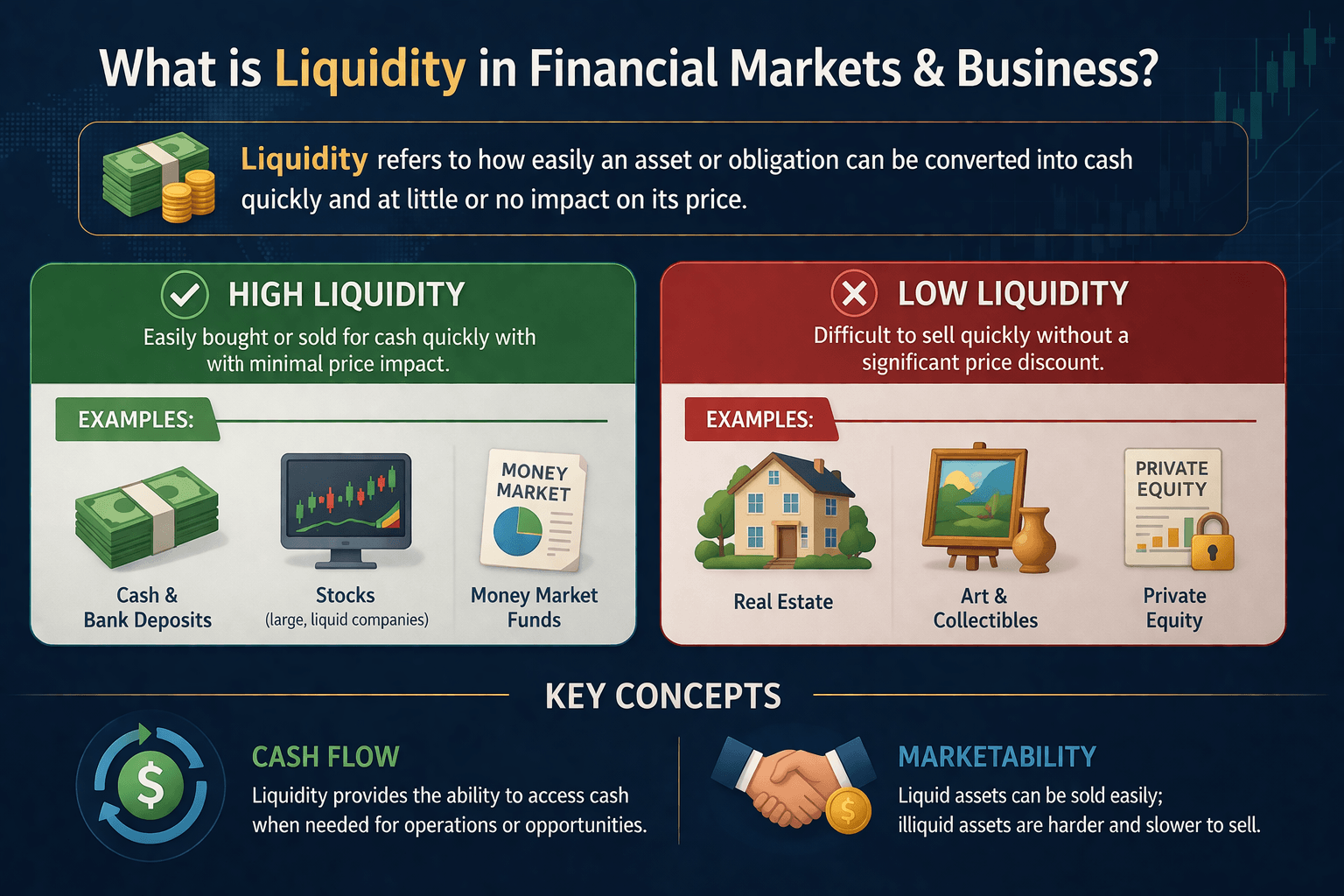
Liquidity is a core concept in both business and finance that refers to available cash or easily convertible (“liquid”) assets. Businesses and marketplaces reduce risk when they hold more liquid assets.
QUOTE
“Liquidity is essential in business. So many businesses fail because of a failure to retain liquidity.”
Hendrith Vanlon Smith Jr, Author
Any commercial entity seeking to survive without ample cash reserves could soon face unpleasant conditions.
For example, Bear Stearns did not have ample liquidity to cover its positions. Thus, the bank was forced to sell its assets at a considerable discount and ultimately went under.
Big ideas
- In markets, a lack of or excess liquidity can be a problem. When a market lacks liquidity, it increases the cost of buying and selling but when it is flooded with liquidity, it often leads to poor investments.
- For individuals, there is more to wealth than overall assets – some of those assets have to be liquid so they can be easily used and exchanged.
- A business with healthy cash reserves is well-positioned to take advantage of opportunities as they arise and to survive adverse circumstances.
What is liquidity in a business?
Business or accounting liquidity refers to how much cash or liquid assets a company has available.
DEFINITION
A liquid asset is easily convertible/redeemable without losing its intrinsic value.
Liquidity is defined by how long it takes to convert an asset to cash and how well it retains its original price when converting it to cash.
Cash is the most liquid of all assets because it is a legal tender that is accepted in a domestic country. The same applies to cash held in a bank account because it can be used at any payment terminal with a debit card.
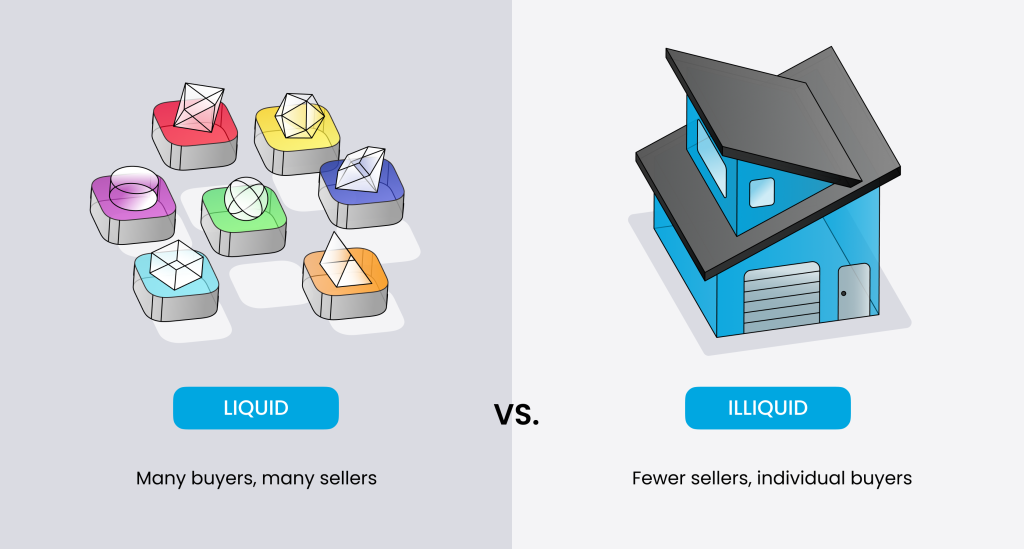
For an asset to be liquid, there must be a market for it to trade. Some markets are known to be highly liquid, with a constant stream of activity. Other markets have low liquidity because they are more niche and exotic, with assets that take longer to buy and sell.
As you can already see, liquidity means different things for investors, business owners, and markets.
On a bigger scale, banks are responsible for providing financial liquidity for the entire market via interest rates, which determine lending costs. Higher interest rates reduce liquidity and lower interest rates increase liquidity.
What does liquidity mean in Investment?
For investing, ultra-liquid assets play a minor role in achieving returns. Modern investment theory is that you should allocate funds towards a particular asset and leave it there to benefit from appreciation over time or to earn interest. In other words, liquid assets are not an investment but more of a way to safe-keep your wealth.
QUOTE
“Liquidity is a good proxy for relative net worth. You can’t lie about cash, stocks, and bond values.”
Mark Cuban, Businessman, Author
Highly liquid assets often generate small returns or no returns in the case of cash. Liquidity in investing mainly refers to keeping cash so you have it ready:
- For potentially lucrative new investment opportunities
- In the case of a crisis to stop you from being forced to liquidate your existing holdings before you planned to
An important point to keep in mind about liquidity is that the asset must hold its price when liquidated. An asset that can be liquidated/sold on the condition that it loses significant value is not truly liquid.
Firms with access to liquidity often capitalise on this. They have the liquidity to purchase at a discount and wait until the asset significantly appreciates. These are sometimes referred to as “vulture funds”, though they are just making smart business decisions on established economic principles.
Examples of liquid assets
A business or investor might also own highly liquid assets, being redeemable for cash nearly instantaneously. This includes treasury bills and treasury bonds. Backed by the US government, these can be easily sold on the secondary market.
Certificates of Deposit (CDs) are also easily convertible, though there can be financial penalties for selling before the maturity date.
Foreign Exchange (FX) is also highly liquid, as it is simply alternative currencies easily swapped for other currencies, and used to purchase assets.
Money Market Funds only hold highly liquid securities, so they are highly liquid themselves.
Major stocks and bonds are also highly liquid, and you can receive payments quickly. With bonds, this will take place on secondary markets, and you might have to sell at a discount.
ETFs and mutual funds are also relatively liquid products, though mutual funds are slightly less liquid as they only trade once a day. In sum, examples of liquid and reasonably liquid assets include:
- Cash
- Treasury bills
- Treasury bonds
- Certificates of deposit
- Foreign exchange
- Stocks (depends on stock)
- Bonds (depends on bond)
- ETFs (reasonably liquid)
- Mutual funds (reasonably liquid)
Examples of illiquid assets
These are not easy to sell for cash in a short time frame. A prime example would be real estate. A house you are trying to sell could spend years on the market.
Intangible assets such as goodwill, brand reputation, and intellectual property are also very illiquid and hard to price. There is no established market for these intangibles, and they are usually only relevant when buying or selling businesses.
Employee stock options (ESOs) are highly illiquid products. These are promised to employees of private companies or startups but are typically not redeemable for a set number of years.
Private equity assets, including venture capital and hedge funds, are regarded as illiquid. This is because there are few individuals with the capital that meet the criteria for investment.
Collectables are highly illiquid. This refers to items such as antiques, jewellery, artwork, and cards that might have a buyer at a high price, but it’s simply not certain to be the case. Collectables, like intangible assets, are hard to price, and this contributes to their lack of liquidity. In sum, illiquid assets include
- Real estate
- Intangible assets
- Stock options
- Private equity
- Collectibles
Over-the-counter (OTC) products are also less liquid than regulated securities. This includes certain derivatives (forwards and swaps). Though a market does exist, it can be harder to find buyers and sellers. For illiquid markets, the brokerages often take a much higher fee.
Asset liquidity table
The following table should give you a good overall indication of the liquidity of certain assets. If you are considering an investment into any of the below asset classes, remember that you’ll have to do your research regarding liquidity.
Many investment vehicles can have terms and conditions that increase or decrease their liquidity. The item to look out for here is the cost of liquidation. You might be able to liquidate a pension fund early, but it will often come at a very steep fee. This cannot be called a liquid asset, even if it can be liquidated, due to the cost.
Precious metals are a mixed category. Silver and gold bullion are quickly redeemable for cash, though you will pay a spread to a dealer. In contrast, raw metals and rare jewellery are harder to liquidate.
| SuperLiquidAssets | HighlyLiquid | LowLiquidity | VeryLowLiquidity |
| Cash | MajorStocks | PennyStocks | Real Estate |
| BankAccounts | MajorBonds | Niche Bonds | Junk Bonds |
| TreasuryBills | ETFs | Trusts | Stock Options |
| Certificatesofdeposit | MutualsFunds | RetirementAccounts | Intangible Assets |
| ForeignExchange | Gold/SilverBullion | Derivatives | Estates |
| – | – | – | Private Equity |
Understanding market liquidity
This refers to the ability to buy or sell an asset in a given market. A liquid market is denoted by a small gap between the buying (bid) and selling (ask) prices. Illiquid markets will typically have a larger gap between the buying and selling prices.
Essentially, the quicker you can sell an asset at a stable price, the more liquid the market. You can sell a major stock tomorrow at a price you can expect. But you might have to wait years to get the price you want for your home. Real estate is a very illiquid market. Foreign exchange is highly liquid because of the huge size of the market and 24-hour trading.
Understanding accounting liquidity
Accounting liquidity is the ability of a business or individual to meet their debt obligations. If you have $40,000 in reserve and an emergency takes place, then you can meet the emergency. If you have no cash at hand (i.e. liquidity), then you will have to sell existing financial holdings, lay off employees, downsize the company, or sell business equipment.
So, how much liquidity is enough? There are many opinions regarding how much liquidity a business should have at hand. A lot depends on the industry and the size of the business. A good rule of thumb is to have between 2% – 10% in cash or highly liquid reserves. This holds for a business or portfolio.
For an individual worker, the common advice from financial advisors is to keep 3 – 6 months of income in an emergency fund, for unexpected circumstances such as job loss or healthcare.
Nuances in measuring liquidity
The ability of a company to pay off its debts and hold cash at hand is a key investment criterion. Lower liquidity is a sign that a company might not be in the best financial health, though there are many other indicators to take into account aside from the liquidity ratio.
High liquidity can also take away from other important metrics that investors look at, including return on equity (ROE) and profitability ratios. Liquidity is essentially uninvested capital and a balance always needs to be struck.
From an economic standpoint, excess money printing and low interest rates are the main contributors to financial bubbles. With excess cash floating in the market, much of it ends up in projects that have no real market viability. This is another situation where excess liquidity can be an issue, prompting illogical expenditure.
Alongside liquidity ratios, inventors and creditors might want to take other factors into account, such as the debt-to-assets ratio, the interest coverage ratio, the equity ratio, and the debt-to-equity (D/E) ratio. In finance, no single formula or equation should be taken on its own, but must be looked at alongside a large number of other definitions to paint a holistic picture.
What is liquidity ratio – measuring liquidity
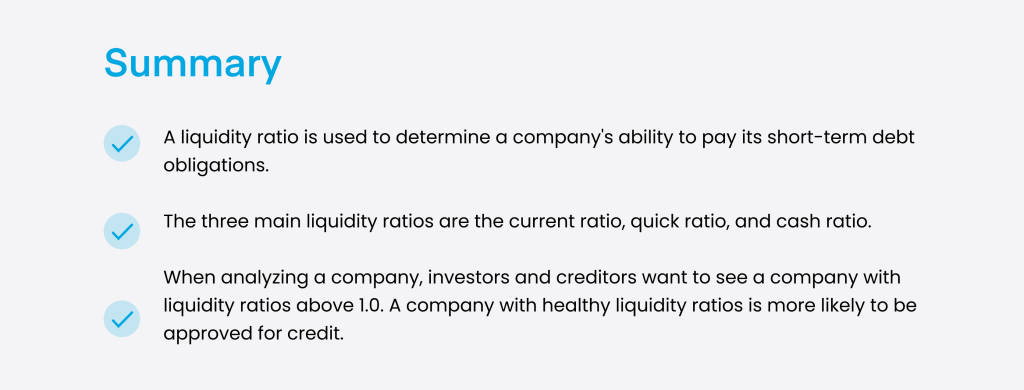
Several metrics help to calculate business liquidity. The three main ones are the current ratio, the cash ratio, and the quick ratio. These ratios are measured by analysts when determining whether or not to invest in a company.
Generally, a liquidity ratio of 1.0 and above is an acceptable level. A company with a liquidity ratio above 1.0 is more likely to qualify for credit. All the liquidity ratios help to calculate how well a company can pay off short-term debt obligation.
The Current ratio is the most simple to calculate, by dividing current assets by current liability. This information can be obtained from the company’s balance sheet.
FORMULA
Current Ratio = Current Assets/Current Liabilities
The Quick ratio gives a more detailed liquidity ratio in comparison to the Current ratio. The Quick ratio leaves out fixed assets and only calculates cash, accounts receivables, and marketable securities.
FORMULA
Quick Ratio = (Cash + Accounts Receivables + Marketable Securities) / Current Liabilities
The Cash ratio is the most detailed of the three liquidity tests. It only considers the most liquid resources, cash and marketable securities.
FORMULA
Cash Ratio = (Cash + Marketable Securities) / Current Liabilities
Keep in mind that the three liquidity tests can generate vastly different results. A company might have a cash ratio of 0.9, a quick ratio of 2.2, and a current ratio of 4.2. A ratio of less than 1.0 can mean that a company is facing a liquidity crisis.
Measuring liquidity in the marketplace
The most common ways to gauge liquidity include the three liquidity ratios. But these apply mainly to business liquidity, where there is a balance sheet to look at. Market liquidity can be measured in different ways.
The first is the difference between the bid/ask spread. This is the difference in the buying and selling of a given asset. In a liquid market, the spread between buying and selling prices will be extremely tight. In an illiquid market, the spread between buying and selling prices will be very wide.
Market liquidity can also be gauged by the total trading volume. Low volume suggests a more illiquid market as there is a fewer number of traders, or just low volumes. In contrast, a high trade volume implies a large and healthy number of market participants.
Of course, it’s helpful to understand that just because a market is liquid, this might not be the case when you are making a trade. Economic and political data can quickly affect the availability of a specific asset. This is why certain markets (Forex, derivatives, commodities) are mainly reserved for trading professionals who are dedicated to a specific niche.
Recap
Liquidity is needed for both investment purposes and for running a business. All theory aside, it’s just good practice to have a small amount of money available for either a rainy day or a sublime opportunity!
Some of the best businesses and the biggest financial institutions have been completely wiped out from a failure to keep liquid assets at hand. And it’s most certainly not a nice feeling having to sell high-quality investments at a discount because of a lack of liquidity.