

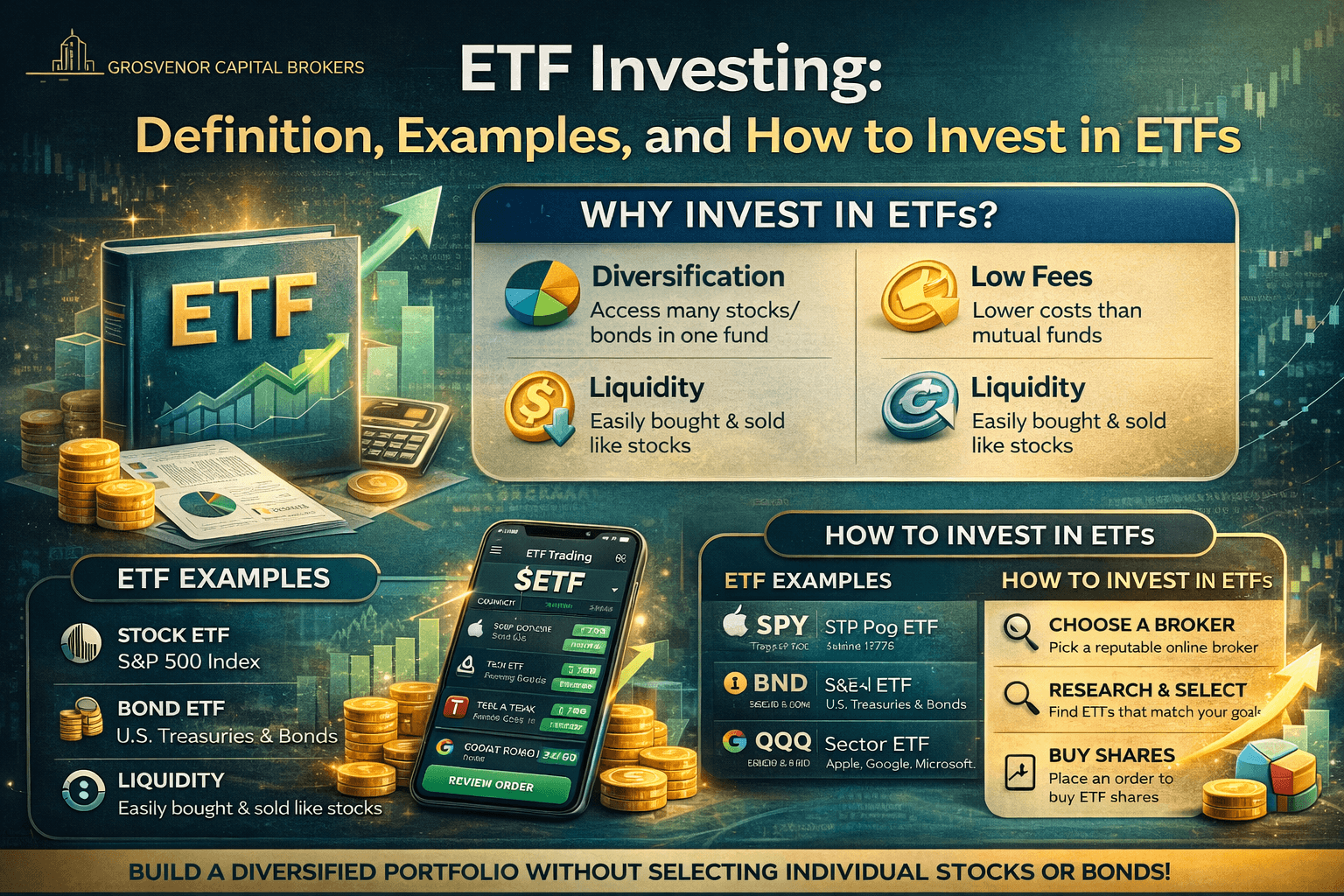
The exchange-traded fund (ETF) is one of the most popular investment options due to its cost, flexibility, diversification, and transparency.
QUOTE
No invention has been more disruptive to the asset-management industry in the last quarter century than the exchange-traded fund.
– Crystal Kim
The ETF has been described as a disruptive technology that could potentially render the mutual fund obsolete. It provides diversification, is passively managed, which means lower costs and can be traded like a stock on an exchange.
Big ideas
- ETFs provide many features ideal for beginners looking for some exposure to the market along with diversification.
- ETFs are designed to match the returns of an index. For market-beating returns, you need to add individually selected stocks as well as other asset classes to your portfolio.
What is an ETF (exchange-traded fund)?
An ETF is a form of investment fund following a specific number of financial securities. The function of an ETF is usually to track the outcome of an index.
ETFs offer you a convenient and cost-effective means to gain exposure to a diversified portfolio of assets without needing to purchase individual stocks or other securities.
Because ETFs track a range of assets, they provide automatic diversification, though investors are unlikely to outperform the market with them unless they add select stocks to their portfolios.
The different types of ETFs
There are many different types of ETFs available; each has a distinct trading strategy and is appropriate for a particular investment objective, so you will have to do research into which one works for you. There are also many subcategories within each ETF sector.
Some of the major ETF variants are shown in the table below:
| ETF Type | Description |
| Equity ETFs | Invest in stocks and seek to track the performance of a specific stock market index (S&P 500, DJIA, Nasdaq, LSE, etc). |
| Bond ETFs | Invest in bonds and seek to track the performance of a specific bond market index, such as the FTSE Pan-European Broad Investment-Grade Bond Index (PEUBIG) or FTSE UK Broad Investment-Grade Bond Index. |
| Commodity ETFs | Focus on commodities, including oil, gas, dairy, wheat, and other commodities. |
| Sector ETFs | Invest in stocks within a particular sector or area, such as energy, technology, healthcare, or agriculture. |
| International ETFs | Invest in stocks or bonds from foreign markets, seeking to track the performance of a specific international market index. |
| Currency ETFs | Focus on currencies and seek to emulate the outcome of a specific currency exchange rate. |
| Inverse ETFs | Structured to generate the exact opposite return of a given market index or benchmark. |
| Leveraged ETFs | Use financial derivatives to amplify the returns of a specific market index or benchmark. |
There are also ETFs that combine multiple investment strategies or invest in alternative assets, such as real estate or private equity. You can choose from a wide variety of ETFs to build a diversified portfolio that meets their specific investment goals and risk tolerance.
How to undertake ETF investing?
Since each ETF has its own ticker on an exchange, investing in one is done the same way as investing in a stock.
It’s important to start by identifying both your investment aims and your risk tolerance levels. This will help you to decide what kind of ETFs are most suitable to your portfolio and how much risk you are comfortable with.
You can then conduct research on different ETFs and compare their performance, fees, and investment strategies.
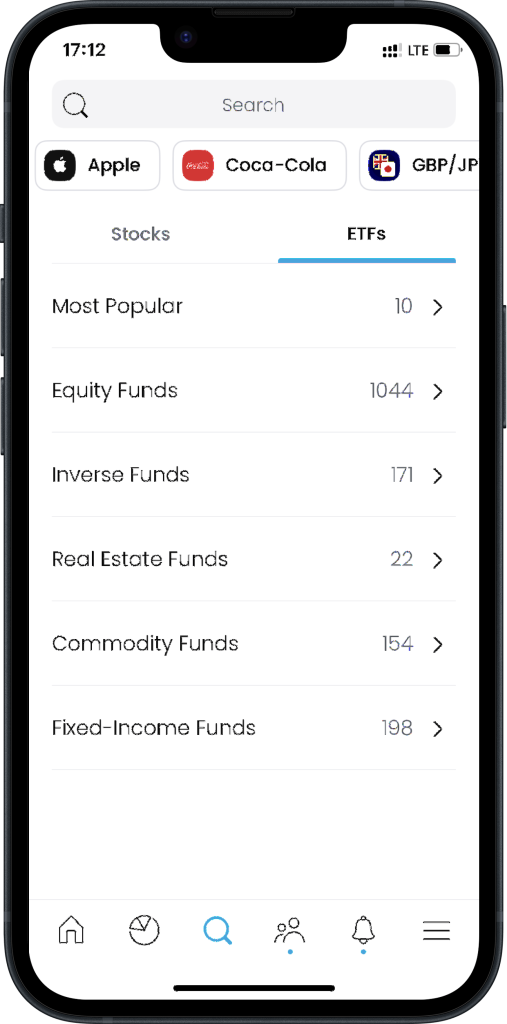
In the Grosvenor Capital Brokers Limited app, when you search for an instrument, you can choose between stocks and ETFs. Under ETFs, you can select by category like Most Popular or use the search bar to search for the name or ticker of the ETF you are searching for.
You can check in on your portfolio periodically to see how it’s performing and to adjust it as necessary in line with market fluctuations and wider economic conditions. Adjusting it based on changes in investment goals, risk levels, personal life events is also common and perfectly reasonable.
ETFs vs Index Funds
Index funds and ETFs both track specific indices, which are essentially baskets of financial securities. A typical example would be the Standard and Poor’s 500 index (S&P 500) or the Dow Jones Industrial Average (DJIA). In the UK, there is the FTSE 100.
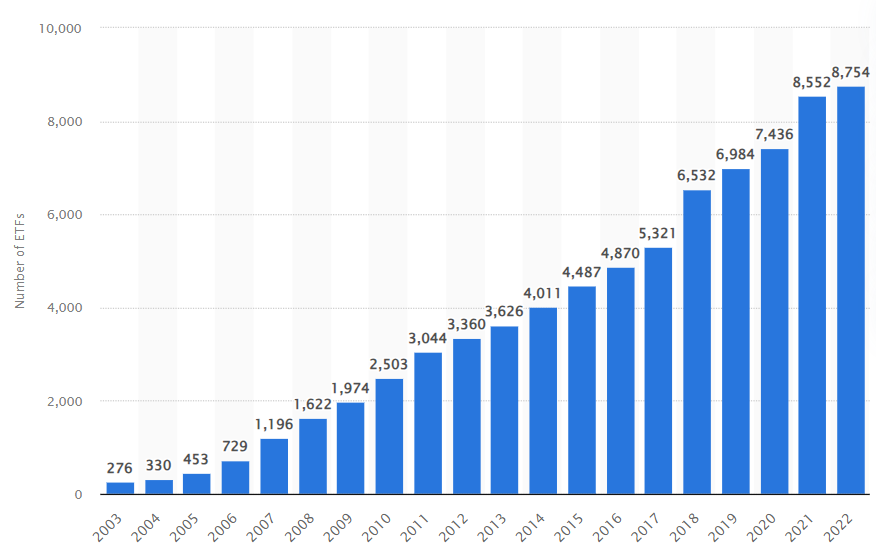
Number of ETFs worldwide by year
The S&P 500 tracks the top 500 companies in the USA as measured by market capitalization and other criteria. The DJIA index is created from the largest 30 companies: “blue chip” corporations that are mainly available on the NYSE. By trading these indexes, you are in essence buying the average performance of a group of stocks.
| Differences | ETFs | Index Funds |
| Trading | Trades like stocks, available throughout the daily trading window | Priced at market closure, only trade at the fund’s price at the end of the trading day |
| Cost | The expense ratio can be lower than index funds | Costs can be kept lower due to passive strategies |
| Minimum investment | No minimum investment required | Some index funds may mandate a minimum investment |
| Fractional share investment | Allows fractional share investment (e.g., 0.2 shares) | Does not typically offer fractional share investment |
| Tax efficiency | More tax-effective, allows trading shares with other investors to minimize capital gains tax liability | Can be less tax-efficient, involves buying and selling securities within the fund itself |
Arguably, the ETF is simply a more modern version of the index fund. By way of analogy, if an index fund is a basic landline phone, then the ETF is a modern smartphone. It costs less, trades throughout the day, is available on exchanges, has lower minimum investments, and is more tax efficient.
ETFs vs Investment Trusts
An investment trust is essentially an investment company which pools money from a variety of investors, allocating it towards specific assets. The trust is managed by a professional investment management team, which selects and manages the asset portfolio. Investment trusts are available for purchase only from the London Stock Exchange (LSE), being native to the UK.
The main difference between investment trusts and ETFs is in their structure and trading characteristics. Investment trusts are closed-end investment companies, meaning it has a fixed number of shares, while ETFs are open-end funds with shares that are created or redeemed based on investor demand.
Finally, investment trusts may be subject to wider bid-ask spreads due to their limited liquidity, which equals a higher cost for the investors; ETFs generally have narrower spreads due to their higher trading volume.
ETFs vs Mutual Funds vs Stocks
There are three major differences between ETFs and mutual funds:
- ETFs are identical to stocks in the sense that they are tradable throughout the day. Mutual funds, meanwhile, are priced at the close of the trading day, making them a little less liquid.
- ETFs are typically passively managed as they track an underlying index, while mutual funds can be actively or passively managed.
- ETFs usually have lower expense ratios (how much of a fund’s assets are used for operating expenses) than mutual funds, which saves you money.
QUOTE
ETF portfolios will be the inevitable default for investors in the years to come because they are lower cost, more transparent and offer greater liquidity and tax advantages than mutual funds.
– Jon Stein
Stocks are quite different from both ETFs and mutual funds. A stock represents a stake in a single company, whereas funds (both ETFs and mutuals) can contain many stocks, so they represent a stake in many companies. A single stock can experience extreme volatility, which is why most investment professionals recommend having a basket of stocks (at least 20 to 25) to promote diversification. Both mutual funds and ETFs provide this diversification by following a significant number of stocks.
ETFs vs ETCs
ETFs (exchange-traded funds) and ETCs (exchange-traded commodities) are both exchange-traded products that can provide you with access to a multitude of asset classes.
The main difference is in terms of the underlying asset they track ie commodities vs stocks. However, they also differ in terms of their structure, regulation, and tax treatment.
ETCs are structured to follow the price of a single commodity, such as gold, silver, or crude oil. ETCs are traded on stock exchanges, much like ETFs. ETFs are typically subject to securities regulations, while ETCs are subject to commodity regulations.
ETCs that hold physical assets, such as gold or silver, may be subject to capital gains tax when sold. ETCs that hold futures contracts or other derivative instruments may be subject to different tax treatments.
ETF examples: typical ETF options in the UK
The following are examples of seven popular ETFs in the UK. They are commonly available through most online trading exchanges:
| ETF Name | Index Tracked | Expense Ratio | Description |
| iShares Core FTSE 100 UCITS ETF | FTSE 100 Index | 0.07% | Tracks the performance of the 100 biggest companies on the LSE |
| Vanguard FTSE All-World UCITS ETF | FTSE All-World Index | 0.22% | Provides exposure to global large, mid, and small-cap companies |
| iShares UK Dividend UCITS ETF | FTSE UK Dividend+ Index | 0.40% | Tracks UK companies with a history of paying dividends |
| Xtrackers MSCI USA UCITS ETF | MSCI USA Index | 0.07% | Provides exposure to US equities |
| iShares Global Clean Energy UCITS ETF | S&P Clean Energy Index | 0.65% | Invests in companies involved in renewable energy and clean tech |
| Invesco Physical Gold ETC | N/A – Holds physical gold | 0.19% | Provides exposure to physical gold, a popular hedge against inflation |
| WisdomTree Physical Silver ETC | N/A – Holds physical silver | 0.49% | Provides exposure to physical silver, diversification in metals sector |
When selecting an ETF, investigate the fund’s objective, expense ratio, and underlying assets for greater clarity. Additionally, become familiar with the typical risks of ETF investing, including wider market conditions, geo-political unrest, and central bank monetary policy, and how this might impact your investment.
How to invest in ETFs?
Fortunately, it’s quite easy to invest in ETFs because they trade like stocks on exchanges. Accessibility is possibly the most enticing aspect of the ETF. Grosvenor Capital Brokers Limited offers a direct means of investing in a wide range of ETFs, with a selection of over 7,000 stocks and ETFs to choose from.
These assets are available with the benefits of fractional shares, zero commissions and a wide variety of stocks and ETFs to choose from. It’s also possible to create your own diversified portfolio and add select stocks to it using an auto-investment feature.
ETFs are available on many trading platforms and are one of the most common options alongside equities. However, it’s important to ensure that your account is secure and fully insured.
Recap
The introduction of the ETF was a game-changer for financial markets. ETFs allow new investors to easily access a diversified basket of securities at a low cost and with preferential tax treatment, although tax treatment depends on individual circumstances and may be subject to change in the future.
ETF investment is mainly passive, which comes with its own drawbacks. While a passive investment works well with a diversified portfolio, this is only true over longer time periods. During periods of market turbulence, ETFs that target a broad common equity index are likely to underperform an active portfolio that had some conservative adjustments to target stocks and securities that fare well under periods of economic hardship.