

Some choices are simple. Let’s say you have two options for your hard-earned savings and investments. Option 1 is giving money to the taxman and Option 2 is keeping all your money.
If you are a UK tax resident aged 18 or over, you do have exactly that choice with Individual Savings Accounts (ISAs).
Tax treatments depend on the individual circumstances of each person and might be subject to change in the future.
Big ideas
- ISAs are a type of savings account where interest income from savings, as well as capital gains and dividends from investments, are shielded from tax.
- They are a government-sponsored scheme to encourage savings and investments, subject to a maximum contribution limit (currently £20,000).
- There are different types to consider, including options for yourself or your children.
What is an ISA?
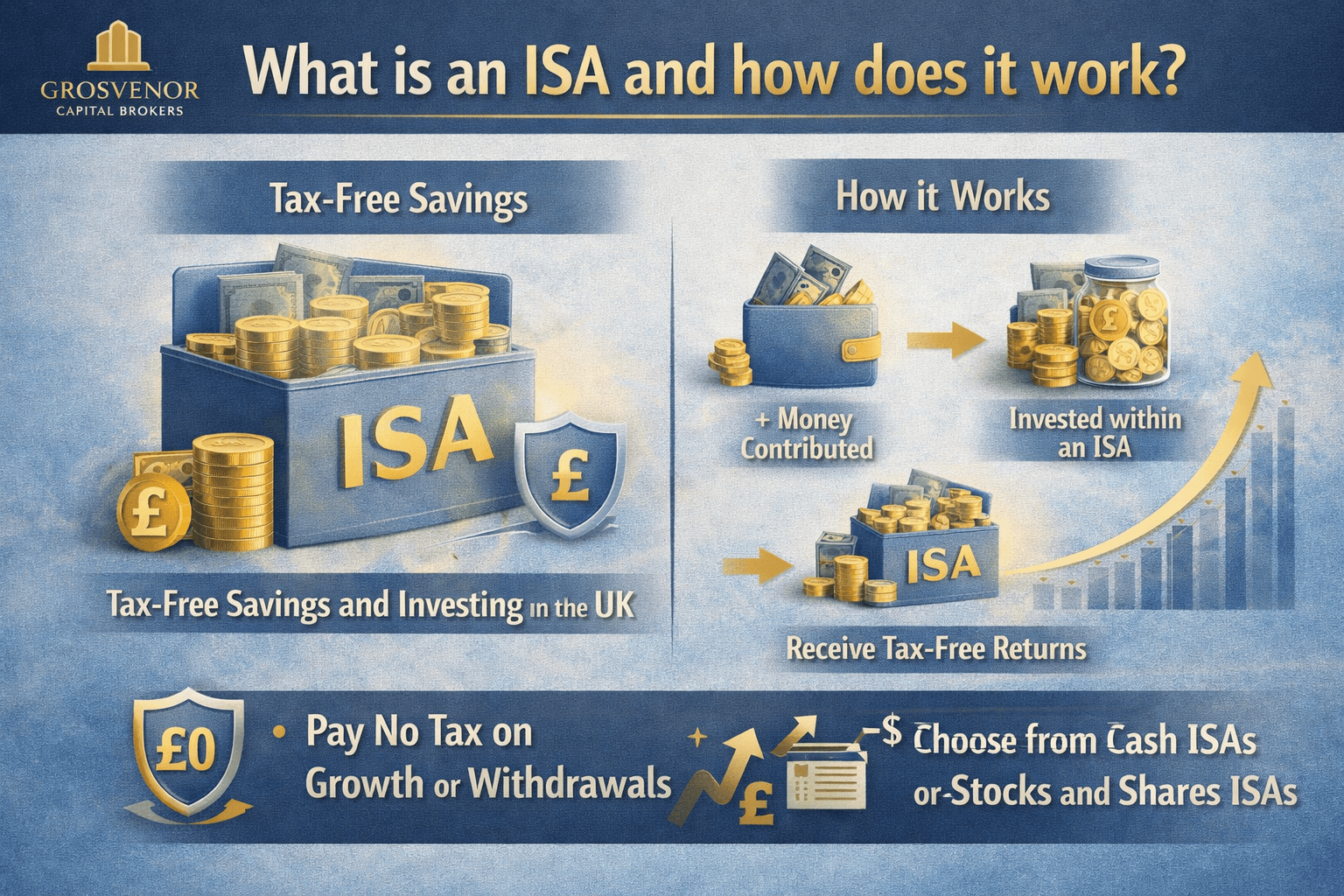
An ISA is a tax-free saving or investment account for UK tax residents aged 18 or over. You can put your ISA allowance to work and maximise your potential returns by shielding them from income tax, tax on dividends, and capital gains tax.
ISA in UK parlance is sometimes referred to as a Tax Wrapper. Think of them like a force field sitting around your money, keeping the taxman away.
What are the UK taxes on investments?
To understand the value of using an ISA, it is worth taking a brief look at how taxes on savings and investments usually work in the UK, without using an ISA. That way you can see what the ISA is protecting you from.
Tax on interest
For cash savings, the tax you pay on interest depends on your income tax band:
- Basic rate taxpayers: The first £1,000 of interest is tax-free, with 20% tax applied to anything above this.
- Higher rate taxpayers: You get £500 tax-free, then pay 40% on any interest over that amount.
- Additional rate taxpayers: No tax-free allowance applies, and 45% tax is charged on all interest earned.
This makes tax-free savings options like ISAs an attractive way to maximise your returns.
Tax on capital gains
This is a tax on the profit made from selling an asset, known as Capital Gains Tax (CGT). You are not taxed on investment profits until you sell the asset and realise the gain.
You have an annual tax-free allowance of £3,000 for profits, after which you pay tax on amounts exceeding this threshold. The rates range from 10% to 28%, depending on your income tax band and the type of asset involved – for example, different rates apply to gains from property compared to stock market investments.
Tax on dividends
Many stocks pay out dividends to investors, which is a type of income you receive, and yes, that is taxed too. You get the first £500 tax-free and then pay between 8.75% to 39.35% on the rest, depending on what income tax band you are in.
Sadly, there is not a lot that the government doesn’t tax! But an ISA is an easy way to avoid all of these (up to a maximum contribution), keeping more money in your pocket. Another benefit is that you don’t have to declare them on a tax return or report them in any way.
What are the different types of ISA accounts?
There are various types of ISAs with different attributes that can help you achieve your investment goals:
DIFFERENT TYPES OF ISA
☑️ Cash ISA for saving cash
☑️ Stocks & Shares ISA for investing in the stock market
☑️ Innovative finance ISA for peer-to-peer lending
☑️ Lifetime ISA for saving to buy your first home (or for later life)
☑️ Junior ISA for tax-free savings and investments for children under 18
Choosing the right ISA for your individual investment goals
When deciding which ISA is best for you, consider your preferences and personal objectives. Your strategy should be aligned with your financial goals. Each ISA type can serve you with a different purpose and advantages. Understanding the various ISA features and limitations is key to optimise their use. Let’s sum them up:
Cash ISA
Typically offered by banks and building societies, Cash ISAs are known for their interest rates and often for their flexibility. Interest rates can be fixed or floating and can go up or down depending on the access you have to your funds. Some Cash ISAs would limit your access to the funds for a fixed term, while others allow you to withdraw at any time.
Before engaging in a Cash ISA, it is good to explore the options available and consider which one is best for you and your investment goals. Whether you pick a Cash ISA with a fixed term and higher interest or instant access at a lower rate, this ISA type offers a good opportunity for passive income.
The Grosvenor Capital Brokers Limited Cash ISA stands out with its competitive AER (variable), zero account fees, and the flexibility to withdraw your funds anytime – all while earning tax-free interest daily.
The best part is that you can combine your allowance usage with another ISA type or choose to use all of it within your Cash ISA. For instance, you can add money to a Lifetime ISA or Stocks & Shares ISA while contributing to a Cash ISA or putting all money into the Cash ISA.
To open a Cash ISA, you need to be at least 18 years old. For Stocks & Shares ISAs or Innovative Finance ISAs, the age requirement is also 18, while Lifetime ISAs require you to be between 18 and 39.
Stocks & Shares ISA
This is the ISA type that allows you to invest in stocks and various assets while making the most of your savings. An important aspect to note is that investments within this ISA can fluctuate in value as markets are volatile. Therefore, it is crucial to consider the risks associated with investing in different securities and market exchanges. Yet, higher risk levels can also mean higher potential returns. An advantage is that you won’t be taxed on any earned interest, income, or dividends.
Unlike Cash ISA and Cash Lifetime ISA, which primarily hold cash, a Stocks & Shares ISA allows for a diverse range of investments such as shares, funds, investment trusts, exchange-traded funds (ETFs), as well as corporate and government bonds. For instance, the Grosvenor Capital Brokers Limited Stocks ISA provides access to a wide selection of individual company stocks and ETFs.
You have the option to maximise the allowance limit set by HMRC or divide it among various ISA types. It is permissible to contribute funds simultaneously into both a Stocks & Shares ISA and a Cash ISA or any other type of ISA.
You have to be at least 18 years of age to open a Stocks & Shares ISA. The allowance for the 2025/2026 financial year set by HMRC is up to £20,000.
In a Stocks & Shares ISA, generally, you can include the following types of investments:
- Funds
- Shares
- Investment trusts
- Exchange-traded funds (ETFs)
- Government bonds (gilts)
- Corporate bonds
Any investments held inside an ISA account will not be subject to income tax, tax on dividends or capital gains. So why don’t we just put everything inside an ISA? The answer is that there is a maximum allowance for how much you can deposit per year.
Innovative finance ISA
Typically offered by peer-to-peer lending platforms, Innovative Finance ISAs let you earn tax-free interest by lending your money to individuals, businesses, or property developers. Returns come in the form of interest payments, and while they can be higher than Cash ISA rates, your capital is at risk and not protected by the Financial Services Compensation Scheme (FSCS).
Before investing in an Innovative Finance ISAs, it is worth comparing platforms, loan types, and risk levels to find the right fit for your goals. Whether you are targeting higher returns or looking to diversify beyond traditional savings and stocks, this ISA type provides a unique way to make your money work for you.
You can split your ISA allowance between an Innovative Finance ISA and other types, such as a Stocks & Shares ISA or a Cash ISA. To open an Innovative Finance ISA, you must be at least 18 years old.
Lifetime ISA (LISA)
Lifetime ISA’s purpose is to help people buy their first home or build a savings pot for later in life. This type of ISA has the lowest subscription limit of all. Investors can add up to £4,000 each year until they are 50 but can take out the savings when they are buying their first home or if they are 60 or over.
The benefit of this ISA type is that the government adds a 25% bonus on the savings per year. For instance, if the maximum limit is used, a bonus of £1,000 will be added by the government. The first payment towards this ISA type must be made after the investor turns 18 and before 40.
The Lifetime ISA can hold both cash and stocks, depending on the provider. Once the investor turns 50, they can no longer contribute or receive the bonus. However, the account remains open, and the funds can continue to grow tax-free through interest or investment returns. More on Lifetime ISAs can be found on the government website.
Junior ISA
The Junior Individual Savings Account (Junior ISA) is a long-term, tax-free savings option for children under 18, designed to help parents or guardians build a financial foundation for their child’s future. For the 2025/26 tax year, the total annual contribution limit for a Junior ISA is £9,000.
If a child has a Child Trust Fund, it can be transferred into a Junior ISA. This may offer better rates or investment options.
There are two types of Junior ISAs, and a child can hold one of each as long as the combined total doesn’t exceed the annual limit of £9,000 for the 2025/26 tax year:
- Cash Junior ISA: Earn tax-free interest on savings.
- Stocks & Shares Junior ISA: Invest in stocks with tax-free growth.
Opening a Junior ISA
- Children under 16: A parent or legal guardian must open the account on the child’s behalf.
- Children aged 16 or 17: They can open a Junior ISA themselves.
Access and control
- At age 16, the child can take control of the Junior ISA and manage how it is invested or saved.
- At age 18, they can access and withdraw the funds.
Benefits of opening an ISA
| ISA type | Subscriptions limit* | Investments type | Age restrictions |
| Cash | 20K | Cash | At least 18 |
| Stocks & Shares | 20K | Stocks, ETFs, bonds | At least 18 |
| Lifetime | 4K | Cash, stocks, ETFs, bonds | Between 18 and 40 |
| Junior | 9K | Cash, stocks, ETFs, bonds | For children under 18 |
* The limits are as per HMRC’s guidelines for 2025/26. As of the 2025/26 tax year, the minimum age to open a Cash ISA has been increased to 18 years. Previously, individuals aged 16 or over could open a Cash ISA, but this has now changed.
ISA withdrawals
You can use your full annual allowance of up to £20,000 in the current tax year by contributing to a Cash ISA, a Stocks & Shares ISA, or an Innovative Finance ISA.
Alternatively, you can split your ISA allowance, using it as you wish across the four different types (subject to individual account limits), as long as you don’t pay in more than £20,000 across them all, and no more than £4,000 into the Lifetime account.
For the 2025/26 tax year, the total ISA allowance is £20,000. If an investor chooses to contribute to a Lifetime ISA, they can pay in up to £4,000 of that allowance. The remaining £16,000 can be spread across other types of ISAs, such as a Cash ISA or a Stocks & Shares ISA, in any proportion, as long as the total contributions across all ISAs do not exceed the £20,000 annual limit.
EXAMPLE
Imagine, you deposited £10,000 and you decided to withdraw £1,000 later on. The balance in your ISA might be £9,000, but your current tax year subscriptions will remain £10,000. So if you decide to add more money afterwards in the same tax year, it will be added on top of your original £10,000, not the new £9,000 value.
ISAs can be flexible
ISAs can be flexible at the choice of the ISA provider.
Where an ISA is flexible, you can replace money that you have previously withdrawn without counting it towards your allowance limit. When a withdrawal is made, new deposits within the same tax year will count toward the limit only when the withdrawn amount has been fully replaced.
You can also withdraw funds contributed in previous tax years. You can replace some or all of these funds up to this amount in the current tax year without affecting your ISA allowance, as long as they are returned to the same ISA account within the current tax year.
ISA rules and maximum contributions
ISAs are a powerful tool for building wealth in the UK, offering tax-free returns on savings and investments. Each tax year (6 April to 5 April), you can save or invest up to £20,000 across a combination of ISA types. This includes Cash ISAs, Stocks & Shares ISAs, Innovative Finance ISAs, and Lifetime ISAs. For those under 18, the Junior ISA has a separate annual allowance of £9,000.
The flexibility of ISAs allows you to allocate your allowance across multiple accounts or concentrate it into one, depending on your financial goals.
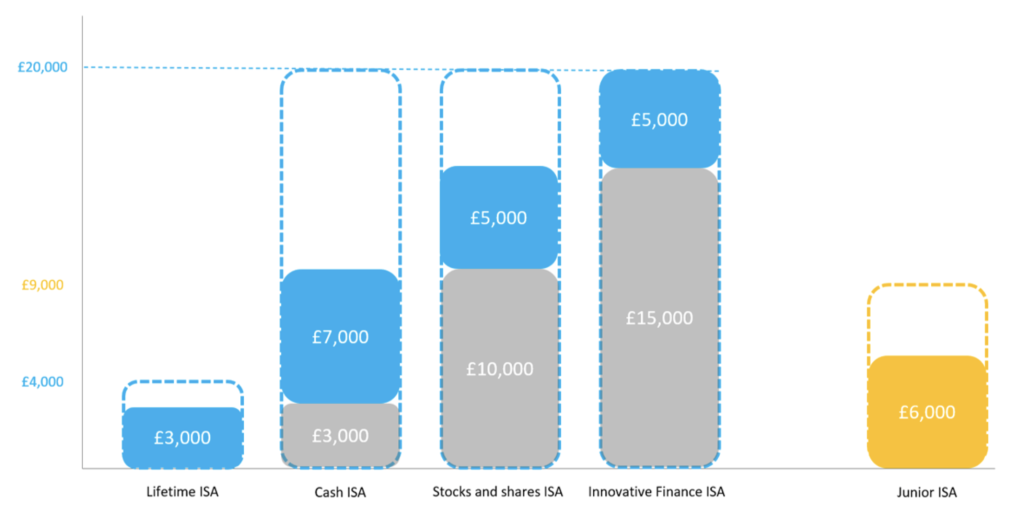
This image shows how you can allocate your annual ISA allowance across different types of ISAs, up to the total limit of £20,000.
You can contribute up to £4,000 to a Lifetime ISA, which counts toward your £20,000 overall ISA allowance.
The remaining £16,000 can be split however you choose between a Cash ISA, a Stocks & Shares ISA, and an Innovative Finance ISA.
If you do not use a Lifetime ISA, you can instead allocate the full £20,000 across any combination of the other three ISAs.
Junior ISAs have their own annual allowance (£9,000 for the 2025/2026 tax year) and do not use up any of your personal ISA allowance.
You have flexibility in how you distribute your contributions, but just make sure not to exceed the overall annual allowance across all ISA types.
ISA transfers
You can transfer your ISA from one provider to another at any time. Transfers can be made:
- Between different types of ISAs (e.g. from a Cash ISA to a Stocks & Shares ISA)
- Within the same type of ISA (e.g. from one Stocks & Shares ISA to another)
In most cases, you can choose to transfer all or part of your ISA, depending on your provider’s rules and the type of ISA.
Types of transfers supported:
- Stocks and cash transfers: Available through the Stocks ISA
- Cash transfers: Available through both the Stocks ISA and Cash ISA
How to transfer your ISA:
- To transfer to Grosvenor Capital Brokers , simply follow the in-app transfer process.
- To transfer from Grosvenor Capital Brokers , contact your new provider – they will initiate your request.
Recap
ISAs are almost indispensable wealth-building tools for those residing in the UK that are worthy of some serious consideration for savings and investments.
For instance, with the Grosvenor Capital Brokers Stocks ISA, you can invest for the long term while retaining the ability to withdraw funds when needed. Keep in mind, however, that the value of investments can fluctuate, and your account balance may differ from what you initially invested. To access your funds, investments must be sold, with the proceeds transferred back to your account as cash. The Grosvenor Capital Brokers Cash ISA stands out with its competitive AER (variable), zero account fees, and the flexibility to withdraw your funds anytime – all while earning tax-free interest daily.
Before committing to any ISA, it is essential to understand the withdrawal rules specific to your chosen account type. This knowledge ensures you can make informed decisions and maximise the benefits of your ISA while keeping your savings aligned with your goals.