

Technology has found a new method to give you a leg up in investing. Sometimes a stock is too expensive for your budget. That’s why Grosvenor Capital Brokers Limited offers fractional share investing.
Big ideas
- You may already own fractional shares without knowing it – dividend reinvestment and corporate actions often create fractional share positions.
- Intentional, strategic fractional investing is a great way to practice dollar-cost averaging when an investor buys stock based on dollar amount continually (for example, $100 of AAPL weekly) rather than waiting for the stock to hit a specific price.
- Fractional investing is how sophisticated retail traders create diversified portfolios at a fraction of the cost.
- In short – fractional ownership is often a good investment in many portfolios.
What are fractional shares?
DEFINITION
A fractional share is anything less than one whole share of a company. Fractional shares come from dividend reinvesting and corporate actions or are bought directly through brokerages that allow “dollar-based investing.”
Fractional shares significantly reduce the cost of entry into a position. Commission-free investing in fractional shares have been a significant market disruptor, largely regarded as democratising access for everyone. Certain stocks and ETFs can cost hundreds of thousands of dollars. But with fractional shares, the investment might run as low as £1.
Fractional shares historically came from dividends and corporate actions, but now Grosvenor Capital Brokers Limited is leading the charge in offering the direct buying and selling of fractional shares.
Receiving fractional shares from dividends
When you own stock, you’re a partial owner of that company and entitled to a portion of its profits. Companies may use those profits to fuel growth, fund investments, or return value to shareholders. Mature companies with limited growth prospects, like AT&T or Coca-Cola, usually return the cash to investors as dividends.
DEFINITION
A dividend is a portion of a company’s earnings (profit) it gives back to its shareholders. The dividend may be cash or in the form of additional shares (uncommon). Dividends are issued per share, meaning each common stock is entitled to an equal amount of money when the company distributes dividends.
Many companies, through brokerages, offer a dividend reinvestment plan (DRIP). A DRIP uses the dividend cash to buy additional stock in the company. But, since dividends are dollar-based, investors rarely get the exact amount needed to buy whole, rounded shares.
Fractional shares account for the break between share price and dividend reinvestments. The DRIP will buy as many shares as the dividend can fund on a whole-share and fractional basis.
EXAMPLE
Rocket Companies (RKT), known primarily for Rocket Mortgage and other financial services, distributed a special (one-time) dividend in 2022. RKT’s dividend was $1.01 per share and was paid to investors on March 22, 2022.
With Grosvenor Capital Brokers Limited, since you can opt-in to dividend reinvestments, the whole dividend distribution would fund the purchase of additional RKT shares.
If you owned 100 shares eligible for the special dividend, RKT sent $101 (100 x $1.01) to your Grosvenor Capital Brokers Limited account, which would, in turn, be used to buy new shares i.e. reinvesting the dividend.
On the distribution date, RKT traded at $10.75 per share so you would have purchased an additional 9.4 shares ($101 / $10.75).
Since $101 isn’t divisible by $10.75, Grosvenor Capital Brokers Limited allocates the “fractions” of shares beyond the whole-share purchase price into fractional shares.
You get fractional shares from corporate actions
Sometimes, corporate executives decide they should split or reverse-split their company’s stock.
DEFINITION
A stock split divides a company’s total shares into a greater number of cheaper ones.
A 2:1 stock split on a $100 stock means the company breaks a whole share into two $50 shares. A reverse split combines existing shares into fewer, pricier stocks. Using the previous example, a company would combine the two existing $50 shares into one if they executed a 1:2 reverse split.
Executives typically split stock if the price is too high for many investors and reverse split if they want to pump up the price. Many high-priced companies did stock splits, including Alphabet, Inc (GOOG), Amazon (AMZN), and Tesla (TSLA). Because all three traded higher than many investors could afford, they split at varied rates to increase their share count and reduce the price per share.
Because splits affect each share, the ratio and total shares an investor owns determine how many “new” shares they get; if the share count isn’t divisible by the split ratio, then the investor will have fractional shares.
Banking giant Citigroup (C) has a long history of stock splits and reverse splits, executing one of the two corporate actions eight times since they began trading publicly in 1987.
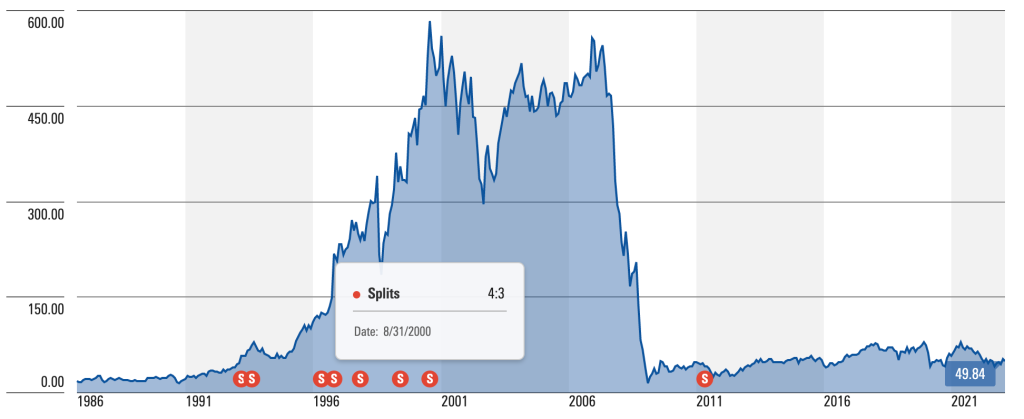
Citigroup’s 2000 split was notable because the ratio wasn’t clean and easily divisible like, for example, Tesla’s 2022 3:1 split where each investor got three shares for each one they held pre-split. Instead, Citigroup elected to split at an unwieldy 4:3 ratio. Only share counts divisible by three saw a round number in their portfolio after the split. All others got fractional shares:
| Before 4:3 Split Share Count | Post-Split Share Count |
| 25 | 33.33 |
| 99 | 132 |
| 100 | 133.33 |
Grosvenor Capital Brokers Limited offers fractional shares in the UK
By using fractional shares, Grosvenor Capital Brokers Limited investors can open positions with more expensive instruments without having to pay for the total cost of a full share.
Most instruments can be traded fractionally from the Invest and ISA accounts in the Grosvenor Capital Brokers Limited. You can invest in stocks like Apple for as little as £1 from the UK, Europe and around the globe.
Additionally, Fractional Market, Limit, Stop and Stop Limit orders are supported, giving you the same flexibility in order types available when trading full share amounts.
You can place a fractional order by choosing either the ‘value’ you want to purchase (in GBP, EUR etc.) or by manually typing in the fraction of the share you want to order. When placing a pending order for fractional shares, you can only set it by the number of shares.
What is fractional trading and investing?
Fractional trading and investing is a tool enabling investors to practice dollar-based investing. Dollar-based investing is allocating specific quantities of money against a stock or ETF rather than thinking of a portfolio in a full share context. I.e., “I want to buy $100 worth of Tesla” rather than “I want to buy one share of Tesla“.
Dollar-based investing and fractional trading let budget-minded investors plan their financial strategy down to the dollar rather than being subject to market conditions driving prices up and down. If an investor has an extra $50 each week from his paycheck and wants to buy into the market through the S&P 500 ETF SPY, he’d have to wait weeks for enough cash to buy a single share! However, he can buy $50 of SPY weekly (roughly 0.125 shares) through fractional shares and automate his investment strategy. Dollar-based investing also facilitates dollar-cost averaging, a popular tool for long-term, buy-and-hold investors.
DEFINITION
Dollar-cost averaging (DCA) is when an investor buys a stock, ETF, or a fraction of either at predetermined time intervals, such as weekly or monthly, rather than basing the trade on the share price.
Over time, the investor buys the stock, whether performing well or in a downturn. This strategy helps investors avoid emotional trading and reduces shorty term volatility’s impact on portfolios.
What are the benefits of fractional shares?
In addition to letting investors execute dollar-based investing and DCA strategies, fractional share trading has other distinct advantages:
✔️ Buy expensive stocks
If a company’s stock price is sky-high, many retail investors are priced out and unable to buy whole shares (for example, AMZN’s pre-split price was nearly $2,500 per share).
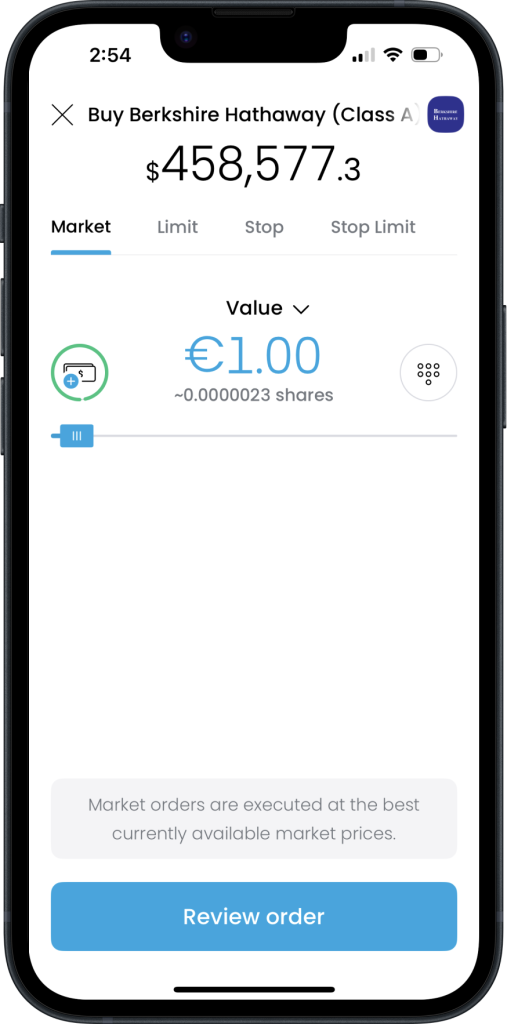
If the company likes keeping the price high and won’t consider a split, like Warren Buffet’s Berkshire Hathaway Class A (BRK/A) shares priced over $400,000, you can use fractional shares to pick up a portion of a company they want to own. In this case, even if you have just one euro to invest, you could buy .0000023 shares of the mega-stock. Not much, but it’s a start!
✔️ Avoid ETF Management Fees
Management companies typically develop ETFs composed of stocks with a common theme. For example, the ETF SPY’s portfolio is all 500 stocks in the S&P 500, and VB consists of stocks from a small-cap index.
Unfortunately, ETFs charge management fees and other costs that cut into an investor’s profit. The fees are low compared to actively managed mutual funds, but they are still there. Using fractional trading and investing lets users replicate a professional ETF independently and avoid overhead.
Ark Investment Management has a portfolio of ETFs centered around themes: innovation, genomics, fintech, robotics, and more. For a time, Ark’s ETFs were outperforming many other investment options. There was a catch, though – Ark Investment Management charged a hefty 0.75% expense ratio that ate into profits and increased the impact of losses as the ETF nosedived.
Grosvenor Capital Brokers Limited users can use fractional shares alongside Pies to replicate the funds and avoid the fees. In fact, there is an Ark ETF Pie already there in the Pie Library in the Grosvenor Capital Brokers Limited app.
Let’s look at Ark’s flagship Innovation ETF (ARKK). ARKK consists of what the firm’s management sees as stocks with the most significant future potential. ETF portfolio holdings are typically available to the public, and ARKK is no different:
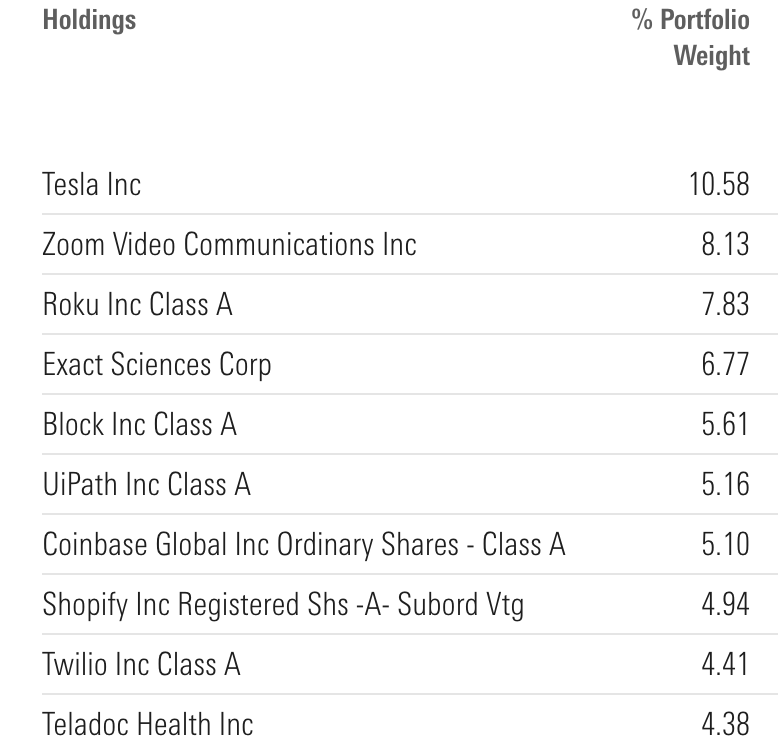
Although these are only the top 10 stocks in ARKK by weight, we’ll assume that they’re the only ten stocks in the ETF for ease. In this case, an investor with $1,000 can replicate the portfolio and each stock’s relative weight with fractional shares, taking advantage of professional stock picking without paying professional fees:
| Company | PortfolioWeight | SharePrice | SharesOwned |
| Tesla | 16.9% | $199.13 | 0.850 |
| Zoom | 13% | $73.27 | 1.775 |
| Roku | 12.5% | $68.50 | 1.829 |
| Exact Sciences | 10.8% | $65.16 | 1.662 |
| Block Inc | 9% | $72.95 | 1.230 |
| UiPath Inc | 2.3% | $15.13 | 5.457 |
| Coinbase | 8.2% | $59.29 | 1.376 |
| Shopify | 7.9% | $42.28 | 1.869 |
| Twilio | 7.1% | $65.97 | 1.070 |
| Teladoc | 7% | $29.36 | 2.387 |
✔️ Diversification of investments
A parallel to replicating ETFs is the opportunity fractional shares give you when seeking diversification. Diversification is critical to traditional investing strategies, and 70/30 stock and bond mixes are popular. Say you want a diversified 70/30 portfolio with only $100, you can buy $70 of Vanguard’s Total Stock Market ETF VTI (0.35 shares) and $30 of their Total Bond Market ETF BND (0.42 shares).
Are there downsides to fractional shares?
With every upside in life, there are downsides. Fractional shares are no different. Although trading and investing fractional shares opens new opportunities to retail and non-institutional investors, some drawbacks exist.
➖ Ease of Selling
It’s essential to remember Grosvenor Capital Brokers has a minimum order size of one full unit of currency. (1.00 GBP, 1.00 EUR, 1.00 USD etc.).
That means you cannot sell fractional shares worth less than 1 unit. For example, if you have fractional shares of GOOG worth 89p, you cannot sell them. This is easily overcome by buying more at zero commission and selling the total amount. Though foreign exchange fees will apply.
Illiquidity (difficulty selling or buying) when trading fractional shares increases the less popular a stock or, the higher the price of an underlying whole-share. Sometimes, sellers or buyers may not be on the other side of the transaction.
For a simplified example, consider BRK/A: if you own 0.006 fractional shares and want to sell, your order must either be packaged with other fractional sellers or matched directly to a buyer who needs precisely $2,400 (assuming a $400,000 share price) worth of BRK/A. The likelihood of either happening for a high-priced stock that’s pretty illiquid on its own is slim.
➖ Downsides to Dollar-Based Investing
Dollar-based investing and fractional shares are great tools to smooth out cost bases and invest spare money regularly. But despite substantial functional upside, there’s a mental downside.
When an investor focuses primarily on the dollar amount of a stock rather than the underlying value, he may lose sight of financial fundamentals and operational successes that make company stock worth buying. Investors are excited to snag a piece of Carvana (CVNA) in August 2021 no doubt though buying a sliver of a $345 stock was a great deal – without examining the fundamental company failures that caused its downward spiral to $10 per share in 2023.
Recap
Fractional shares have been on the market for years through dividend reinvestment opportunities and corporate actions like mergers, acquisitions, or stock splits. Only recently has fractional share trading and investing exploded amongst retail traders, but for a good reason.
Fractional trading and investing is an excellent opportunity to dollar-cost average into a position, diversify portfolios, and even replicate the experts’ funds without the fees. The word is out, and many investors are looking for the best fractional shares to buy in 2023 as inflation makes their budgets tighter, but they’re still planning for their financial future.
All investments come with risks and should be considered carefully. Fractional trading is the same and comes with the additional risk of confusing the dollar cost of stock with the actual value or quality of the underlying company. Still, prudent investors use fractional trading and investing as powerful tools in their stock market arsenal.